

UW–Madison grad student’s research builds off Dairy Soil & Water Regeneration project
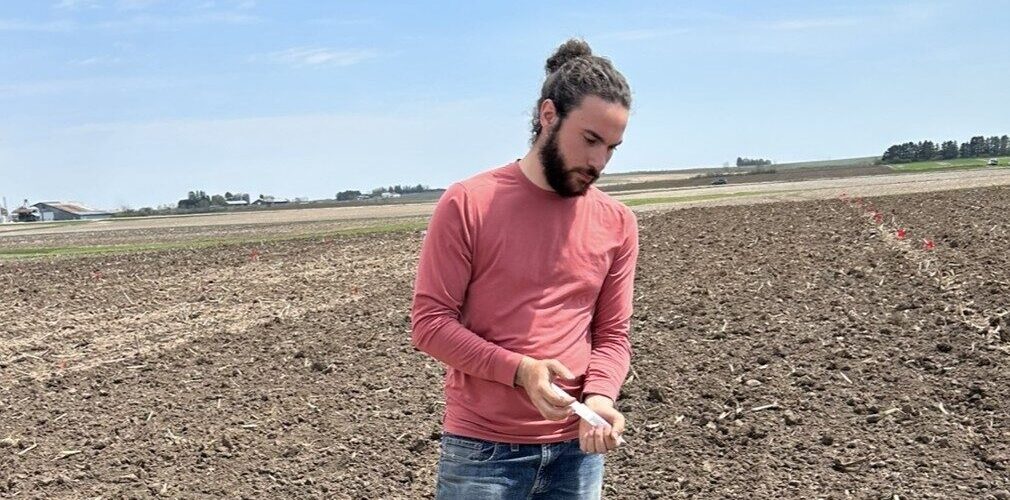
Field work normally ends before dark, but following a long day of dairy manure application in early May 2023, University of Wisconsin-Madison graduate student Josh Mirabella worked late into the night to install his soil greenhouse gas (GHG) measurement equipment.
The GHG measurements would begin early the next morning, making it essential to deploy the equipment as soon as possible. Guided by only a headlamp and a distant tractor light, Josh tromped through the recently manured field, pounding the cylindrical steel collars that would be used for the measurements into the soil. This was not exactly glamorous work, but Josh knew that ultimately his efforts would provide critical new knowledge about nitrogen applications in dairy forage systems.
Collaborating with the UW-Madison team working on the Dairy Soil & Water Regeneration (DSWR) project, Josh and his faculty adviser, Xia Zhu-Barker, developed a research project with the goal of understanding whether novel manure products could improve the retention of nitrogen fertilizer when both were applied to corn silage.
If certain manure products could improve the retention of nitrogen fertilizer in a corn silage crop, then perhaps less nitrogen fertilizer would need to be applied to fields in the long term. This reduction would be a benefit from both economic and environmental perspectives, as the nitrogen fertilizer would amount to a lower input cost for the farmer, and less nitrogen would be lost to groundwater and the atmosphere.
While some previous studies had investigated the nitrogen retention of more traditional manure products, such as liquid dairy manure and dairy manure compost, much less is known about emerging solid manure products, such as flocculated and evaporative solids — both of which are heavily featured in the DSWR research. These manure products result from treatments that separate the solids and liquids in the slurry. Flocculation uses a chemical additive that aggregates fine particles into larger clusters called flocs. Evaporative solids result from processes that remove the moisture through evaporation, often by using heat.
Although technically separate from DSWR, Josh’s project is an example of how DSWR can be used to spark additional questions and broaden the impact of the research.
Sub-experiment within DSWR
Working at a recently established DSWR site, Josh set up a sub-experiment within the existing study field to test his questions. The premise of the experiment was to mimic a typical late-spring nitrogen fertilizer application in corn, except that the fertilizer would be labeled with the 15N isotope (a form of nitrogen with the same number of protons but differing neutrons), which would allow the fertilizer-derived nitrogen to be tracked into the corn plants, soil and nitrous oxide, a potent GHG.
By applying the isotopically labeled nitrogen fertilizer to areas that had previously received liquid dairy manure, flocculated solids, evaporative solids or no manure, the effect of different manure products on nitrogen fertilizer retention in plants and soil could be evaluated. Moreover, by sampling the nitrous oxide gas emitted, the emissions derived from the nitrogen fertilizer could be separated from the other emissions occurring from the manure and soil.
Like most field research experiments, Josh’s findings were not entirely what he expected, but they provided new and important information. Surprisingly, the type of manure applied did not affect the amount of nitrogen fertilizer taken up by plants or the amount of nitrogen fertilizer emitted from soil as nitrous oxide gas. However, compared to liquid dairy manure, application of the two novel manure products increased the amount of nitrogen fertilizer that was bound to soil minerals one year after the manure solids and nitrogen fertilizer were applied.
An important step forward
In practice, Josh’s findings imply that manure solids do not hinder corn’s ability to take up nitrogen fertilizer, yet manure solids can promote the retention of nitrogen fertilizer in soils for one year after application, which may then be available for the next crop to use.
While more work is needed to understand the long-term implications, Josh’s work provides an important step in highlighting a potential benefit of manure solids in dairy forage systems. Josh successfully defended his Master’s research in December 2024, and he recently published his findings in the scientific journal Biology and Fertility of Soils, both of which are major achievements.
Yet, this is only the beginning of Josh’s dairy research endeavors. Drawing upon his passion for improving environmental outcomes, Josh is already fully engaged in his Ph.D. project, which aims to understand the effects of dairy cow diets and genetics on GHG emissions from the barn, manure storage area and the field. Josh is hopeful that the results of this project will illuminate attainable pathways to reduce the overall GHG footprint of dairy production.
So far, Josh’s new project has not required him to wander through the field after dark, but he knows that if the situation should ever arise, the new knowledge obtained will be well worth the effort.
To read the published findings of Josh’s study, see: https://link.springer.com/article/10.1007/s00374-025-01946-w
This story was originally published on the Dairy Soil & Water Regeneration website.