

Wisconsin Crop Innovation Center celebrates decade of accomplishments, looks forward to next 10 years
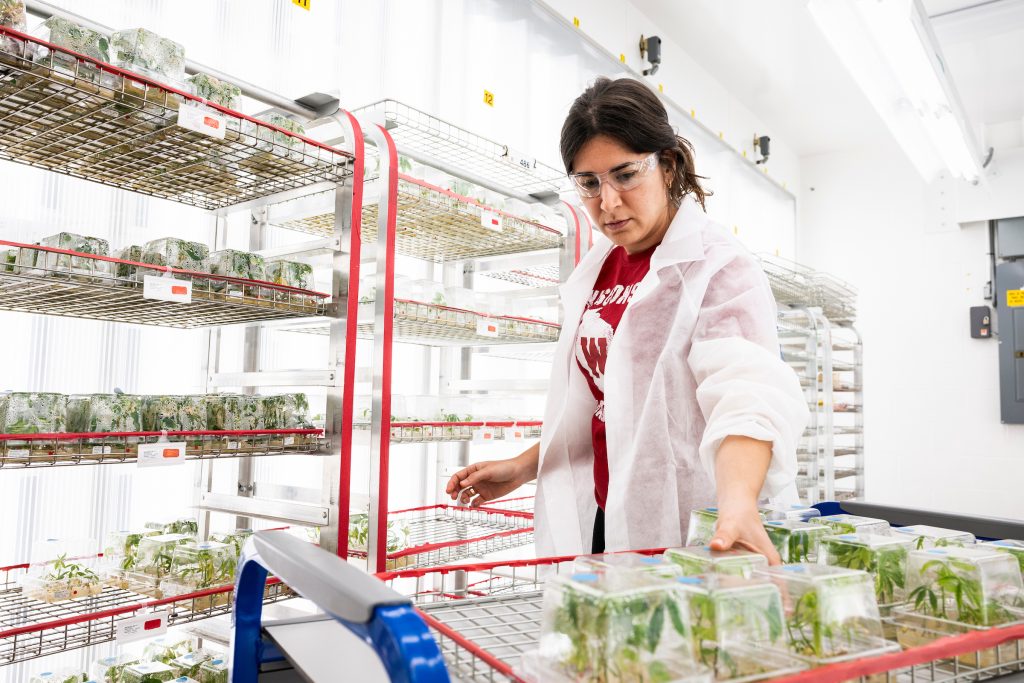
When the Wisconsin Crop Innovation Center launched in early 2017, there were high hopes the facility would become a nationally recognized facility for plant transformation services and collaborative research – and it has truly delivered.
Originally the facility offered plant transformation in just three crops – corn, soybeans and sorghum. Now clients can select from more than 22 species, including alfalfa, barley, banana, cassava, hemp, oat, pea, potato, tomato and wheat. While at the beginning, WCIC scientists could only add one gene at a time in one or two cultivars, now they can add many genes needed for a given molecular pathway to operate – all at once. Since its inception, WCIC has produced over 33,000 transgenic events for more than 150 scientists across 35 states and 22 countries. Clients include universities, government agencies, non-profits and private companies.
“Looking back over the past nine-plus years, WCIC has been a major driver of innovation in plant biotechnology, supporting the development of resilient, high-yielding and sustainable crops,” says WCIC director Shawn Kaeppler, a professor in the Department of Plant and Agroecosystem Sciences. “Over that same period of time, people have become much more comfortable with gene engineered and edited crops. It’s possible now for people to buy biotech seeds and grow them at home such as the Norfolk Purple tomato. So much as changed over the years.”
The WCIC is a full-service operation, conducting fee-for-service activities and contract research such as vector design, gene editing, crop transformation, molecular analysis and seed production. At the same time, the center is well known for its pioneering work to develop novel genetic engineering tools for crops, tools that can enhance the efficiency and reliability of transformation systems. A major focus has been overcoming genotype-specific barriers to transformation, with the goal of creating efficient, broadly applicable systems for diverse crops.
WCIC researchers developed the “wox2a” tool, for instance, which makes it significantly easier to work with elite corn varieties, including sweet corn and tropical maize. WCIC has used this tool to add helpful traits like better nutrition and stronger growth. The GAANTRY system, another important tool used at WCIC, was co-developed at the USDA by current WCIC scientist Ray Collier. This system helps researchers put very large pieces of DNA into plants—much bigger than older methods could handle. In some plants, like hemp and cassava, GAANTRY succeeded where older methods failed completely.
Using GAANTRY, for instance, WCIC developed the first gene-edited cannabis variety in the world – Badger G Hemp – which is completely THC free, giving growers a risk-free variety to produce. This line has been licensed by WARF to several commercial companies. WCIC also created Badger PMR, which is completely resistant to powdery mildew, a fungus known to severely impact hemp yields in certain environments. Earlier this year, the USDA approved these hemp lines to be grown in fields just like non-engineered crops, paving the way for hassle-free commercial production by farmers.
“The Wisconsin Crop Innovation Center is a key resource for plant scientists on campus and around the globe,” says Glenda Gillaspy, dean of the College of Agricultural and Life Sciences. “We are excited about the contributions the center will make during its second decade.”
The WCIC facility, located at 8520 University Green, has 100,000 square feet, which includes 20 greenhouses, 15,000 square feet of controlled environments and 50,000 square feet of laboratory space. This represents more than half of the total greenhouse space available to UW–Madison plant researchers. The building is owned by University Research Park and leased to CALS. CALS is renewing lease for another 10 years – with financial support from central campus.
The facility, which first opened as Cetus in the early 1980s and was later acquired by Monsanto Corporation, is the site of landmark innovations in plant biotechnology, including the development of the first engineered soybean and cotton. From the start, it was designed to handle large-scale projects, and it is well-positioned to handle the future projects that arise from Artificial Intelligence-based explorations.
“AI can consider 1000s of genomes within a species, and researchers can use it to identify interesting genes for cold tolerance, for instance. It might give you 100 genes, and you can screen all of them, no problem,” notes Kaeppler. “We have the capacity at WCIC to handle large-scale experiments – 100s and 1000s of plants for a given project.”